The results on knowledge depreciation have important implications for both opera- tional and strategic decisions in organizations. On the operational side, depreciation has important ramifications for forecasting, planning, and scheduling. If knowledge depre- ciates, forecasts based on the conventional learning curve will systematically overesti- mate future productivity. The gap between an organization’s actual and
Many researchers have speculated about factors responsible for the productivity gains observed in organizations with increasing experience. For example, Joskow and Rozanski (1979) discussed the following factors as contributors to the produc- tivity gains observed with increasing experience: routinization of tasks, more efficient production control, improved equipment design, and improved routing and material handling.
How do these examples of sources of productivity gains relate to more theoretical discussions of organizational memory or of where knowledge is embedded in orga- nizations? Stein (1995) defined organizational memory as the means by which knowledge from the past is brought to bear on present organizational activities. According to Stein (1995), “memory is
Although empirical work on organizational learning and memory has increased in recent years (Miner & Mezias, 1996), there is little empirical evidence about the consequences of where knowledge is embedded for aspects of organizational per- formance. We are just beginning to understand the effect of organizational memory on organizational outcomes. An empirical study that
What is a group? Guzzo and Dickson (1996) defined a group as “made up of indi- viduals who see themselves and who are seen by others as a social entity, who are interdependent because of the tasks they perform as members of a group, who are embedded in one or more larger social systems
Research on group learning is relevant for understanding organizational learning for two reasons. First, groups are increasingly being used as a form of organizing— both in the executive suite (Ancona & Nadler, 1989) and on the factory floor (Hoerr, 1989). Understanding how groups learn helps us understand how the organizations they constitute learn. The
Groups develop knowledge through several processes. Groups can elicit or share knowledge that one of their members already possesses or generate new knowledge through collaboration and interaction. Another process of group learning involves a “weighting” or evaluating of information that has been shared or generated. This involves influence attempts on the part of those
The general pattern found on a variety of tasks is one of groups being superior to individuals (certainly the “average” individual, and sometimes even the “best” indi- vidual—see Reagan-Cirincione, 1994; Weldon & Bellinger, 1997) and of groups improving with experience. Groups are better than individuals on recall (Hinsz, 1990) and induction tasks (Laughlin &
When knowledge acquired in one organization affects another (either positively or negatively), transfer of knowledge occurs (Argote & Ingram, 2000). A long tradition of research in psychology examines whether individuals are able to transfer knowl- edge from one situation or task to another (e.g., see Thompson, 1998). This work examines whether experience with one
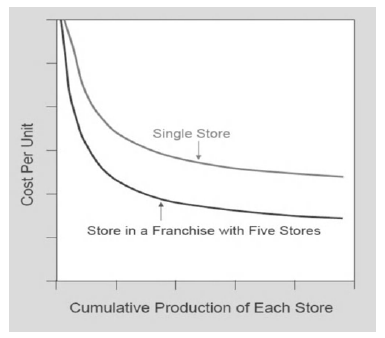
Our primary goal in the franchise study (Darr, Argote, & Epple, 1995) was to assess the extent to which knowledge transferred across organizations. That is, we wanted to examine whether one organization learned or benefited from experience at another. A secondary goal for the franchise study was to determine the extent to which knowledge
Knowledge transfer in organizations has been studied at different levels of analysis. This section provides an overview of whether knowledge has been found to transfer at these different levels. Subsequent sections identify the conditions under which knowledge transfer is most likely to occur. Several researchers have examined whether knowledge transfer occurs across products or
Although interest in how one organization transfers knowledge to another is rela- tively new, considerable work has been done in the past on related topics. For example, work has been done on “transfer of training.” This work examines how to design training programs to increase the likelihood that participants transfer skills acquired in the
This section identifies the conditions under which knowledge transfers across orga- nizational units. That is, the section identifies the conditions under which experi- ence in one organization affects another. The section is organized into examining how knowledge transfer is affected by characteristics of the relationship among the organizations, characteristics of the organizational context, features
It is challenging to transfer knowledge across organizational units. Several reasons why it is difficult for one unit to benefit from the experience of others have to do with the nature of experience. A unit’s own experience is likely to be more relevant than the experience of other units. As noted previously, differences in
The research reviewed in this monograph suggests that the relationship between learning processes and outcomes at different levels of analysis needs to be better articulated (e.g., see March, 1991; Miner & Haunschild, 1995). Whether, when and how learning at different levels of analysis complements each other, substitutes for each other or are independent of
The research findings presented in this monograph suggest several relationships across dimensions of experience that would benefit from greater articulation: the relationship between direct and indirect experience, the relationship between het- erogeneous and homogeneous experience and the relationship between experience before doing and experience during doing. 1. Direct and Indirect Experience The relationship between
This section develops managerial and strategic implications of new results in orga- nizational learning for market entry decisions, for the development of organiza- tional capabilities and competitive advantage, for the success of new entrepreneurial ventures and for the design of experience in organizations. 1. Market Entry Researchers have examined the conditions under which it
Four new trends in research on organizational learning curves were noted in Chap. 1: examining a wider set of outcome measures and a broader set of organizational contexts, understanding why some organizations are better at learning than others, analyzing the dynamics of knowledge acquisition and loss by organizations, and understanding the conditions under which knowledge
Hacked by CoupDeGrace Greetz: Hmei7, BrokenPipe, SimSimi, L4663r666h05t, AntonKil, d3b~x, Index Php, Mdn_Newbie, Sultan Haikal, Brian